
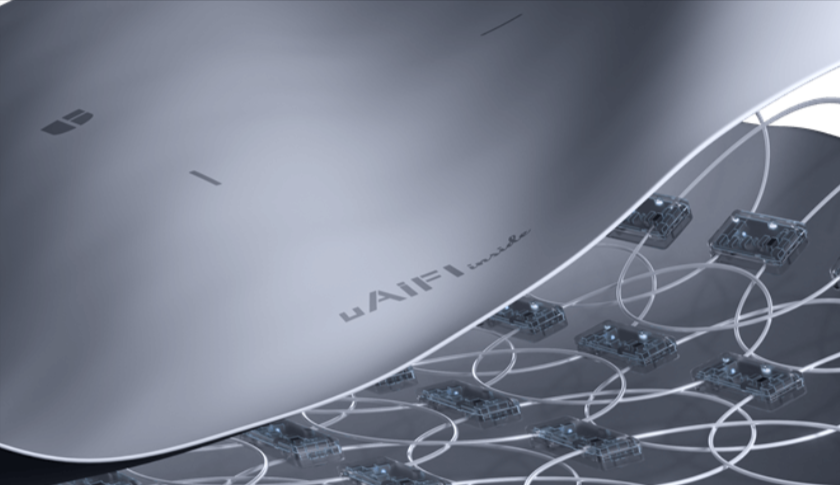
Traditional coils are often rigid, plastic structures that can be heavy, hard, and ill-fitting for the patient’s anatomy. United Imaging Healthcare (UIH), as part of its uAIFI smart platform, is introducing a solution that turns this “armor” into a “second skin.” uAIFI SuperFlex Coil is a technology that literally “hugs” the patient, offering unprecedented comfort while increasing diagnostic quality.
The problem of the “rigid cage” in traditional MRI
The standard coil used to examine the torso, pelvis, or joints often resembles a rigid cage.
- Placing a heavy plate on the patient’s chest or abdomen (especially after surgery, trauma, or in elderly patients) causes pressure, pain, and difficulty breathing.
- The rigid coil does not fit perfectly to the body’s irregular shape. Air gaps are created, which distance the receiving elements from the signal source, negatively affecting image quality (signal-to-noise ratio – SNR).
uAIFI SuperFlex Coil – technology that envelops
United Imaging solved this problem by designing a new generation of coils – the uAIFI SuperFlex Coil. The company’s engineers moved away from the concept of rigid housings in favor of flexibility and lightness.
“Blanket-like feeling”
This is the key comparison used by the manufacturer. SuperFlex coils are soft and flexible. Instead of lying under a heavy device, the patient feels as if they are covered with a light blanket. The advantages of this solution are:
- Anatomical adaptation: The coil wraps around the area being examined – whether it is the knee, arm, or abdomen of a bariatric patient.
- Thermal and tactile comfort: The material is skin-friendly, which reduces the stress associated with contact with “cold medical equipment.”
Higher RF element density
However, comfort is not everything. In the world of medical physics, signal quality is key. SuperFlex coils are not only comfortable—they are a powerful engineering tool. United Imaging has used a higher density of RF elements (receiving antennas) in them.
Why is this groundbreaking?
- Signal proximity: Thanks to its flexibility, the coil adheres directly to the skin. In magnetic resonance imaging, signal strength decreases with the square of the distance. The closer the coil is to the tissue, the stronger the signal it receives.
- High SNR: The combination of coil proximity and high element density results in a significant improvement in the signal-to-noise ratio (SNR). This translates directly into higher image resolution and the possibility of shortening the examination time.
Who benefits the most?
uAIFI SuperFlex Coil technology offers benefits in a wide range of clinical cases, but for certain groups of patients it is a real godsend. Which groups are we talking about?
- Pediatrics. Children are often afraid of being immobilized by heavy objects. The lightweight, “blanket-like” coil is much less stressful for them, which makes it easier to cooperate during the examination.
- Orthopedics and rheumatology. In the case of painful joint swelling, a rigid coil can cause pain with every contact. SuperFlex gently adapts to a swollen knee or shoulder without applying point pressure.
- Postoperative patients. People with fresh wounds after abdominal or chest surgery may not tolerate the pressure of traditional coils well. The UIH solution minimizes the risk of wound irritation.
- Bariatric patients. Combined with the wide opening of the uMR Omega system (75 cm), flexible coils allow for the examination of patients with unusual dimensions, where standard rigid coils might not close or fit in the gantry.
Better workflow
From the perspective of medical staff, SuperFlex coils also save time and improve work ergonomics.
Technicians do not have to struggle with stiff clips or choose the size of the coil from several available rigid options. The coil adapts universally to the patient.
The coils are lighter, which reduces the risk of strain injuries for staff who perform dozens of examinations every day.
Summary
The introduction of the uAIFI SuperFlex Coil is further proof that United Imaging Healthcare prioritizes the “humanization of technology.” Replacing hard plastic with a smart, flexible material with high-density RF elements is a win-win situation. The patient enjoys the comfort of a “hug,” while the radiologist receives crystal-clear images resulting from the laws of physics. It is a technology that bridges the gap—literally and figuratively—between humans and machines.
