
Introduction
You lose a tooth on a Tuesday. By Friday, you are wondering whether you will be chewing on one side of your mouth for the next six months.
That worry sits behind most implant questions patients bring to a consultation. A tooth implant traditionally meant placing the post, waiting months for the bone to heal around it, then fitting the crown. Same-day treatment attaches a temporary tooth on the day the post goes in, so nobody sees a gap.
Both routes work. They suit different mouths, and your jawbone usually decides which. Here is how each one runs, who suits what, and what to ask before you agree to anything.
Table of contents
- How a traditional tooth implant works
- What “same day” actually means
- What the appointment day is actually like
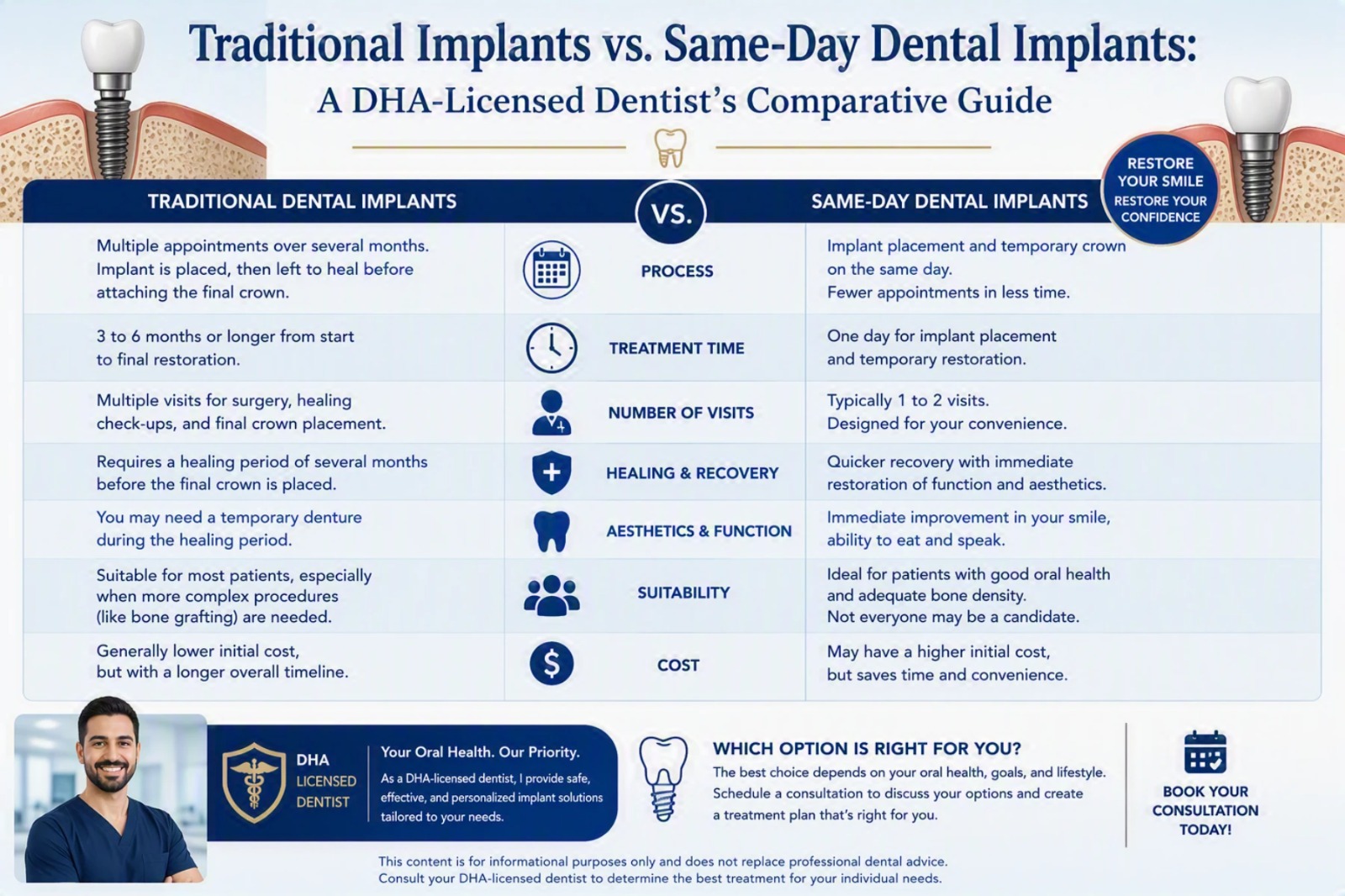
- Traditional vs. same-day in brief
- Who suits same-day treatment, and who is better off waiting
- Questions worth asking before you agree to anything
- Living with your implant afterwards
- Conclusion
- Contact us
How a traditional tooth implant works
The traditional approach divides the treatment into stages, with a built-in period of healing between them.
When you go for your first visit, the dentist numbs the area and inserts the implant post into the bone; the gum is then closed over the post or a small healing cap is placed on it. After that, you have to wait, typically a few months, while the bone grows around the surface of the post and secures it in position. Dentists refer to this process as osseointegration, and it cannot be sped up since it is biology that is carrying out the work, not the dentist.
When the bone has recovered, a second short appointment is required in order to fit the connector piece, and at that time impressions or a digital scan are taken for the crown, after which the final crown is placed.
A temporary denture or a bonded tooth is generally provided if one of the front teeth is affected in order to avoid having a noticeable gap at that time.
What “same day” actually means
Same day dental implants, a procedure also known as immediate loading, shorten the first stage of the timeline since the post is put in and a temporary crown is placed over it all in the same visit.
One thing that patients frequently get wrong is that the tooth you take home on that day is only a temporary arrangement. The bone still requires the same number of months to heal around the post. The final crown—which is the one designed to cope with full chewing force—will be provided later. All you obtain is the look and function of a tooth from the very first day, not a reduced healing time.
In order for this to work safely, the post must fit tightly into the bone from the very first moment it is inserted. This initial hold makes it possible to attach a temporary tooth without interfering with the healing. If the bone is soft or thin, then this tight fit may not be achieved, and premature loading of the implant could be to your disadvantage.
What the appointment day is actually like
Patients tend to exaggerate in their minds the extent of the surgery beyond what the appointment actually warrants. A single implant is a routine operation carried out using local anaesthetic, and most people experience pressure rather than pain during it.
When you arrive, the scan and treatment plan are gone over once again, and the area is numbed; if the tooth still has to be removed, this is carried out as gently as possible in order to keep the surrounding bone intact since that bone is what the implant will depend on. The post is then inserted through a small hole in the gum, and a single implant usually takes less than an hour of treatment time, although more complicated cases and those involving several implants take longer.
When you receive same-day treatment, a temporary crown is shaped and then put into place before you leave; in the case of the staged method, the area is closed, and you take home some instructions along with a follow-up appointment.
The numbness will last for a few hours. If you’re not sure about driving, plan a calm evening and get a lift, and have something soft in the other part of your mouth.
Traditional vs. Same-day at a glance
| What patients ask about | Traditional implants | Same-day implants |
|---|---|---|
| Temporary tooth on day one | No, fitted separately if needed | Yes, in most cases |
| Number of surgical visits | Usually two stages | Usually one |
| Healing time before final crown | Several months | Several months |
| Bone requirement | More flexible, grafting can be planned | Needs enough firm bone at placement |
| Eating in the first weeks | Normal on the other side | Soft foods, avoid biting on the new tooth |
| Suits complex cases | Often the safer option | Assessed case by case |
Who suits same-day treatment, and who is better off waiting
The choice generally depends on what the scan reveals. Since a CBCT scan provides a three-dimensional image of the jaw, the dentist is able to see the bone height, thickness, and the positions of the nerves and sinuses before any treatment is planned. Guesswork has no place in implant treatment.
Same-day treatment is usually chosen when there is adequate bone volume, when there is no active gum infection at that site, and when the bite will not place excessive pressure on the temporary tooth. The front teeth are common choices, not only because patients care about their appearance but also because the chewing forces in that area are smaller.
It is usually the wiser decision to wait if the extraction site is infected, if a bone graft is required first, or if extensive grinding places strain on the implant at night. Since both smoking and uncontrolled diabetes have an effect on the healing of the gums and bone, your dentist will inquire about them; this is not being intrusive, rather it will cause the treatment plan to be altered.
A dentist who advises you that the conventional method is the better choice isn’t attempting to sell you a more gradual treatment; rather, they are aiming to ensure the desired outcome.
Living with your implant afterwards
Most people do not realise how important the first two weeks are. You should eat soft foods, avoid biting directly on the new tooth, and clean gently in the area. If there is any swelling or discomfort, it should be brought to your dentist rather than being dealt with by guesswork.
Once it has been fitted, the implant is looked after in much the same way as a natural tooth by brushing it twice a day, cleaning between the teeth with floss or an interdental brush, and attending regular hygiene appointments. The health of the gums around the implant is what ensures its stability over the years, which is why these check-ups are not optional.
The length of time that an implant will serve you is more influenced by your daily habits than by the brand of the post. Gum disease, uncontrolled grinding, and missing hygiene visits are typically the reasons why implants become troublesome some years later. People who take care of the gums around the post experience considerably fewer problems.
Clinics in Dubai that provide dental implants generally arrange a follow-up visit shortly after the implants have been placed and then once the final crown has been fitted. You should keep these appointments even if you feel everything is okay, since small problems spotted early on—such as a loose screw or mild gum inflammation—can easily be corrected; problems of the same kind ignored for a year cannot be.
Conclusion
Deciding between traditional and same-day dental implants is a clinical decision, not one that you select by ticking a box on a form. Although same-day treatment provides convenience and the advantage of having a tooth to see right away, the traditional, step-by-step method allows more opportunity to deal with bone problems before the implant has to bear any load. Both methods involve the same healing process underneath.
If you’re thinking of getting a tooth implant, you should arrange for an assessment, look at the scan with your dentist and find out why one solution has been suggested instead of the other. A good explanation is worth more than a quick timeline.
Contact us
The Magnum Dental Clinic has patients at four sites in Dubai and is open every day of the week.
Name: Magnum Dental Clinic – DSO
Address: SIT Tower 101, Nr Choitram Super Market, above Baskin Robins Ice-cream, Dubai Silicon Oasis, Dubai, United Arab Emirates
Phone: +971 54 336 3340

